

When the first settlers of Ayetoro arrived on the Ondo coast in 1947, they were confronted with both opportunity and challenge. The vast Atlantic Ocean stretched endlessly before them, offering fish and trade routes, while the swampy, sandy terrain beneath their feet posed a serious question: how could they build lasting homes on ground that shifted with every tide?
The answer was ingenuity. In the late 1940s, Ayetoro’s earliest houses rose not from the ground but above it—built on stilts that allowed families to live safely in harmony with the water.
Ayetoro was founded by members of the Holy Apostles’ Community, a group of fishermen and visionaries determined to create a utopian Christian settlement. Their guiding principles were faith, equality, and hard work. These ideals extended even to architecture.
Using strong mangrove logs, the settlers constructed stilts driven deep into the soft coastal earth. These stilts supported wooden floors and bamboo walls, topped with roofs of raffia or palm fronds. Ladders connected the homes to the sandy ground below, while wooden walkways linked one house to another, creating a network of elevated living spaces.
The design was practical: it kept homes dry during flooding, allowed air to flow freely beneath the floors, and discouraged snakes and other creatures from entering. But it also symbolized resilience—a community refusing to let the environment dictate its destiny.

Life in the stilt homes carried a rhythm unique to Ayetoro. Families gathered on verandas overlooking the lagoon, where children learned to climb ladders almost as soon as they learned to walk. Women cooked in raised kitchens, their smoke drifting into the sea air. Fishermen could paddle canoes directly beneath their homes, unloading the day’s catch into baskets hoisted up by ropes.
At night, the sound of waves lapping against the stilts lulled residents to sleep. The homes seemed to float above the tide, at once fragile and strong. Oral histories tell of the laughter of children echoing across wooden planks and of neighbours calling to one another from verandas, their voices carried by the sea breeze.
Life in the stilt homes carried a rhythm unique to Ayetoro. Families gathered on verandas overlooking the lagoon, where children learned to climb ladders almost as soon as they learned to walk. Women cooked in raised kitchens, their smoke drifting into the sea air. Fishermen could paddle canoes directly beneath their homes, unloading the day’s catch into baskets hoisted up by ropes.
At night, the sound of waves lapping against the stilts lulled residents to sleep. The homes seemed to float above the tide, at once fragile and strong. Oral histories tell of the laughter of children echoing across wooden planks and of neighbours calling to one another from verandas, their voices carried by the sea breeze.
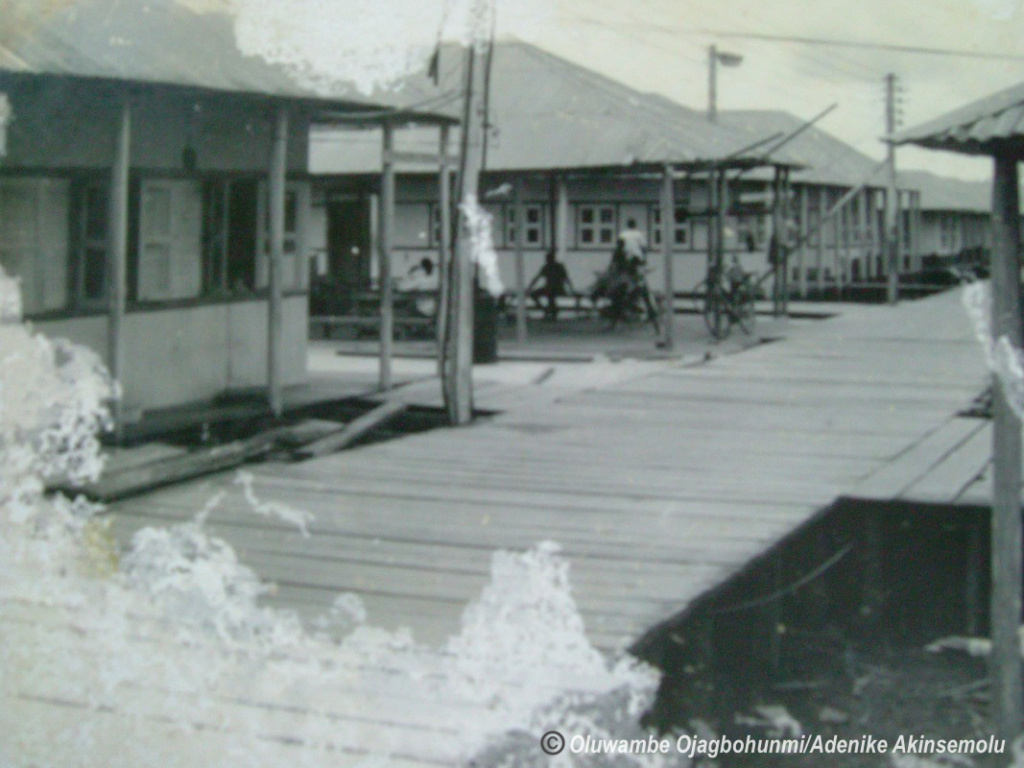
By the mid-1950s, as Ayetoro prospered through fishing and trade, the community transitioned from stilt houses to more permanent structures of concrete and zinc. The palace, schools, and health centres rose during this era of growth, replacing bamboo with brick. Yet, the memory of those early stilt homes endured. They represented the courage of a people who began with almost nothing but built a thriving society at the edge of the ocean.
Today, as erosion and rising seas threaten to erase much of Ayetoro, the wisdom of the 1940s stilt builders feels prophetic. Their homes were light, adaptable, and designed to work with the water rather than against it. While modern concrete houses crumble under the assault of waves, those simple wooden structures demonstrated an early model of climate resilience.
For younger generations, the story of the stilt homes is more than nostalgia—it is inspiration. It reminds them that their ancestors were not passive victims of the sea, but creative visionaries who adapted to their environment with ingenuity and faith.
Though the original stilt houses no longer stand, their legacy lives on in photographs, oral histories, and the memories of elders who once climbed those ladders and played on those walkways. They remind us that the foundations of Ayetoro were not just physical but spiritual—planted firmly in unity and resilience.
The early homes on stilts remain a chapter in Ayetoro’s enduring story: a community born of the sea, tested by the sea, and yet always finding ways to rise above it.


