

In Ayetoro, twins were not only children; they were blessings. To see a mother carrying twins on her back was to witness joy multiplied, a sign of abundance and divine favour. In the 1950s and 1960s, such moments were often marked by song, as neighbours…

In Ayetoro of the 1950s and 1960s, life was not defined only by worship and work. It was also full of play, energy, and joy. Among the most cherished pastimes of the town’s young people was football, played not on grass fields or manicured pitches,…

During the 1960s, the Ayetoro community expanded its economic and social infrastructure beyond fishing and trade to include a number of cooperative enterprises. Among the most notable of these initiatives was the Cooperative Tailoring Workshop, an organised effort to strengthen local skills, provide employment, and…
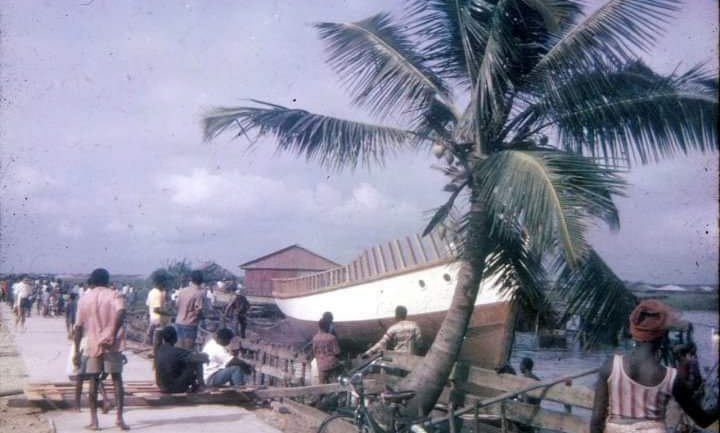
In the mid-1950s, as Ayetoro grew from a fledgling settlement into a thriving community, education became one of its proudest achievements. At the heart of this vision stood Ayetoro Primary School — a modest wooden structure with open windows and a sandy yard, where the…

If dawn belonged to the fishermen of Ayetoro, then the day belonged to its women. By the time the boats returned and nets were hauled in, the shoreline had already begun to transform into a bustling market space. Women spread out along the sand, arranging…

Before the first light touched the horizon and long before the town stirred to life, Ayetoro’s fishermen were already awake. In the quiet hours before dawn, the shoreline came alive with the soft shuffle of feet, the whisper of the tide, and the low murmur…